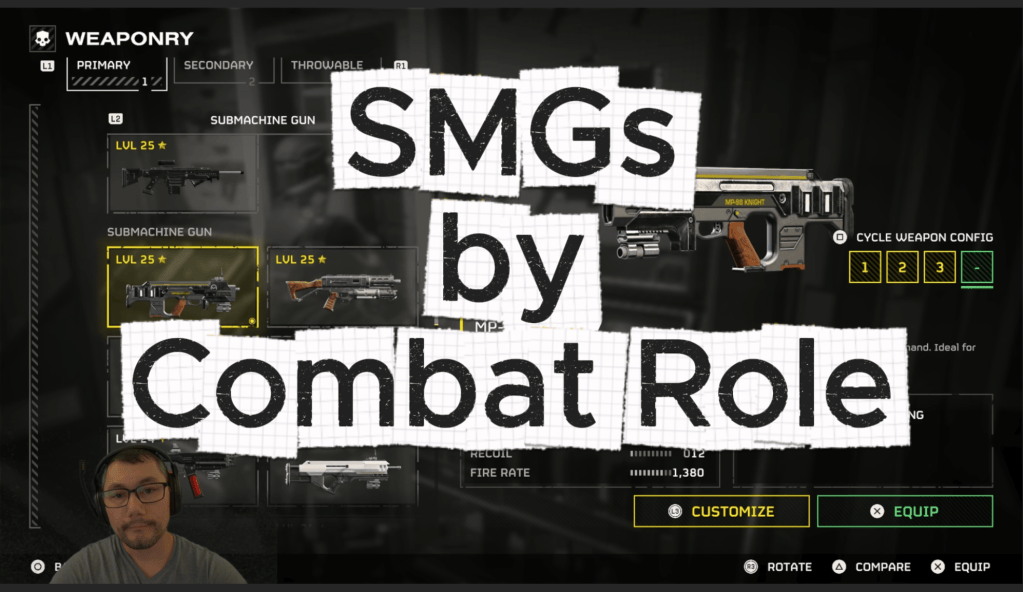
Not every SMG in Helldivers 2 is trying to do the same job. Some specialize in shredding chunky unarmored targets, others trade raw damage for armor penetration, and still others lean into stealth, crowd control, or hybrid utility. This is my combat-role breakdown of the entire class—and an expanded written companion to my video, including some additional analysis on durable damage and armor penetration that I did afterward.
- SMGs Make More Sense When You Stop Treating Them Like Worse Assault Rifles
- The SMG Class at a Glance
- The General SMG Combat Envelope
- Think of SMGs as Primary-Slot Sidearms
- MP-98 Knight: Greater Chaff Shredder
- SMG/FLAM-34 Stoker: Defender Meets Crisper
- StA-11 SMG: The Balanced High-Output Option
- M7S SMG: Stealth as a Primary Role
- SMG-32 Reprimand: The Primary-Slot Verdict
- SMG-203 Gallant: The Medium-Penetrating Emergency Delete Button
- SMG-72 Pummeler: Mobile Crowd Control
- SMG-37 Defender: The Baseline and Jack-of-All-Trades
- Ammo Economy Is More Than “How Many Bullets Do I Have?”
- The Hidden Variable: Durable Damage
- A Practical Durability Rule for Players Who Don’t Want a Spreadsheet
- Knight vs. Gallant: A Near-Perfect Example
- Fleshmob: Where the Knight Pulls Ahead
- Alpha Commander: Where Medium Penetration Starts Paying You Back
- This Pattern Extends Beyond SMGs
- The Alpha Commander Head as a Cross-Class Case Study
- Defender, Stoker and Reprimand Show the Spectrum
- Why I Didn’t Put All of This Math in the Video
- Concise Combat Roles for Every SMG
- So Which SMG Should You Use?
- Sources and Further Reading
SMGs Make More Sense When You Stop Treating Them Like Worse Assault Rifles
I recently finished a video breaking down every current submachine gun in Helldivers 2 by combat role.
The main reason I approach weapons this way instead of simply ranking them from S-tier to F-tier is that the raw number printed on the weapon card rarely tells the whole story.
A weapon might have higher damage per shot but fewer rounds. Another might have lower damage but substantially better armor penetration. One might have enormous theoretical DPS but enough recoil to make actually delivering that damage difficult. Another might sacrifice killing speed almost entirely in exchange for crowd control.
Then there are the things the game either barely explains or does not show players at all: durable damage, projectile velocity, drag, sway, stagger, and a long list of other underlying statistics.
So my question is not simply:
“Which SMG is the best?”
It is:
“What job does this weapon do, and what targets allow it to do that job efficiently?”
That distinction matters a lot.
This article is the expanded written companion to my video, Every SMG Explained by Combat Role | Helldivers 2. It preserves the practical conclusions from that extemporaneous discussion while adding some of the details I deliberately left out of the video—particularly the relationship between armor penetration, hidden durable damage, target selection, and ammunition economy.
The SMG Class at a Glance
For comparison, these are the baseline ballistic characteristics I used while evaluating the class. Attachment choices can obviously alter handling, magazines, recoil, and other properties on weapons that support customization.
| SMG | AP | Dmg/ Dur | RPM | Mag / Total | Raw Damage / Mag | Raw Damage / Total |
|---|---|---|---|---|---|---|
| MP-98 Knight | Light | 90/18 | 1,380 | 50/400 | 4,500 | 36,000 |
| SMG/FLAM-34 Stoker | Light* | 130/30 | 420 | 45/270 | 5,850 | 35,100 |
| StA-11 SMG | Light | 90/18 | 1,050 | 48/384 | 4,320 | 34,560 |
| M7S SMG | Light | 90/18 | 872 | 48/384 | 4,320 | 34,560 |
| SMG-32 Reprimand | Medium | 140/32 | 490 | 25/250 | 3,500 | 35,000 |
| SMG-203 Gallant | Medium | 65/13 | 1,380 | 50/400 | 3,250 | 26,000 |
| SMG-72 Pummeler | Light | 85/17 | 475 | 45/360 | 3,825 | 30,600 |
| SMG-37 Defender | Light | 110/22 | 520 | 45/360 | 4,950 | 39,600 |
*The Stoker’s ballistic rounds are Light penetrating, while its underbarrel flamethrower has Heavy penetration.
A couple of things immediately jump out.
The Gallant and Reprimand illustrate why damage per shot by itself is not enough. The Reprimand hits for 140 while the Gallant hits for only 65, yet their jobs are not remotely identical.
Likewise, the Knight’s 2,070 theoretical DPS is tremendous, but delivering that damage without overspraying targets requires substantially more trigger discipline than using something like the Defender or Stoker.
And while the Gallant carries 400 rounds—the same number as the Knight—its 26,000 raw ballistic damage across the combat load is dramatically below the Knight’s 36,000.
Meanwhile, the humble Defender carries 39,600 raw damage, the highest ballistic total of the SMGs in their default configurations.
That is why I keep coming back to combat roles.
The General SMG Combat Envelope
Across my testing, I think the SMG class makes the most sense when treated primarily as a short-range weapon class.
My practical recommendation is to think in roughly these bands:
Close range: inside about 15 meters
Short range: roughly 15–25 meters
Beyond 25 meters: increasingly situational
Around 40 meters and beyond: projectile behavior and damage falloff become considerably more noticeable
That does not mean an SMG becomes useless at 26 meters.
I have tested SMGs retaining certain damage breakpoints surprisingly far beyond their intended combat envelope. The bigger problem is that a theoretical damage breakpoint and a practical engagement range are not the same thing.
Most SMG projectiles have relatively low velocity, substantial drag, and normal gravity. As distance increases, you have to deal with more travel time, more leading of moving targets, more bullet drop, recoil, sway, and eventually enough damage falloff to lose useful breakpoints.
Compare that with something like the standard Liberator. In my testing, the Liberator retained its three-shot Warrior head breakpoint from close range all the way through roughly 70 meters, while its Brood Commander head breakpoint remained seven shots through approximately 60 meters before finally increasing.
That is the sort of range consistency an assault rifle buys you.
The SMG instead asks:
What can I gain by giving up some of that reach?
And the answer can be a lot.
Think of SMGs as Primary-Slot Sidearms
One of the biggest conclusions I reached while doing this testing is that SMGs make more sense if you stop looking at them exclusively as short assault rifles.
Instead, I increasingly think of them as something closer to:
“Supercharged pistols occupying the primary slot.”
That framing explains many of their strengths.
Most SMGs are one-handed. That allows you to continue firing while jogging, use them with the Ballistic Shield or other compatible equipment, and fire while carrying certain objective packages.
They are compact and responsive at the ranges where pistols normally make sense, but they have substantially larger magazines, greater ammunition reserves, higher sustained output, and—in several cases—select-fire capability.
Put an SMG into semi-auto and suddenly the relationship becomes even clearer.
You can deliberately place one or two rounds into Lesser Chaff, weak points, or isolated targets, and then switch to burst or automatic fire when a chunkier enemy gets in your face.
Judged against an assault rifle, an SMG can look compromised.
Judged as a primary-slot sidearm, many of those compromises become features.
MP-98 Knight: Greater Chaff Shredder
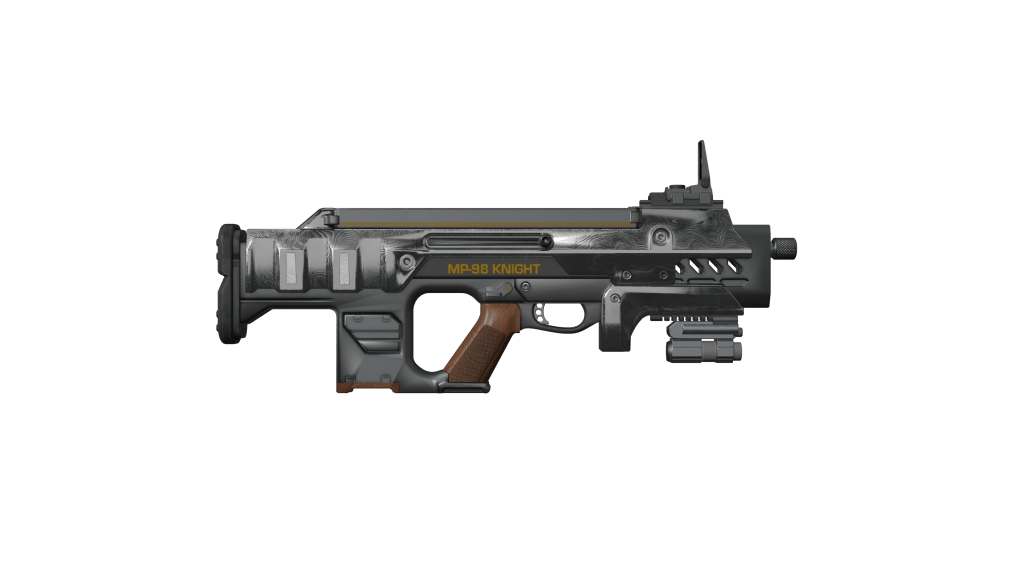
Primary roles: Greater Chaff Killer, Utility
Secondary roles: Lesser Chaff Killer, conditional Elite Killer
The Knight is the raw-output monster of the class.
It deals 90 damage per shot at an absurd 1,380 RPM, giving it roughly 2,070 theoretical DPS. It also carries 50 rounds by default and 400 rounds across a full combat load.
The attraction is obvious.
Put a sufficiently chunky enemy in front of it at close range and let it rip.
The problem is that 1,380 RPM is also extremely easy to waste.
Against something like a Scavenger, Pouncer, or another Lesser Chaff enemy that only needs one or a few hits, holding down the trigger guarantees that several additional rounds are already leaving the barrel before the target has finished dying.
That is not the gun having inherently terrible ammunition economy. That is the player using a high-volume weapon inefficiently against a target that does not justify the volume.
This is why I strongly recommend learning the Knight’s semi-auto and three-round-burst modes.
Against Lesser Chaff, use trigger discipline.
Against Warriors and other Greater Chaff, you can open it up more.
Against Brood Commanders, Alpha Commanders, Stalkers, Fleshmobs, and similar chunky close-range threats, full-auto fire starts making much more sense.
The Knight is also customizable. You can reduce vertical recoil, change muzzle devices, and even increase magazine capacity, but those improvements come with the usual tradeoffs in ergonomics, sway, reloads, or reserves.
Even built for recoil reduction, however, the Knight remains a lively weapon.
That is part of its identity.
Bring the Knight because you want to exploit 1,380 RPM—not because you want to pretend the recoil does not exist.
SMG/FLAM-34 Stoker: Defender Meets Crisper
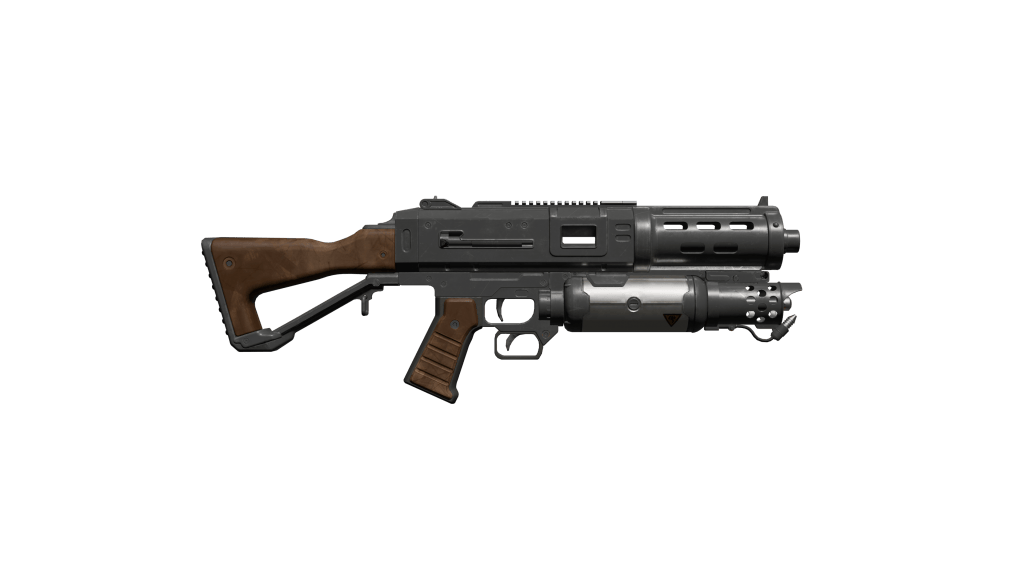
Primary roles: Greater Chaff Killer, Utility
Secondary roles: Crowd Control, Elite Killer, limited Heavy-target capability
The Stoker may be the easiest SMG to explain conceptually:
It is roughly a harder-hitting, slower Defender with a Crisper bolted underneath it.
Its ballistic round deals 130 standard damage and 30 durable damage, substantially more per projectile than the Defender’s 110/22.
It fires at only 420 RPM, however.
That gives the Stoker an interesting combination: its listed ergonomics are not exceptional, but the relatively low cyclic rate and low recoil make it feel extremely stable in actual use.
Its default 45-round magazine contains 5,850 raw ballistic damage, the highest default magazine total in the SMG class.
The tradeoff is ammunition volume.
The Stoker carries only 270 ballistic rounds versus the Defender’s 360.
That makes overkill particularly important.
If you fire a 130-damage round into something that only needed a fraction of that damage, you have spent capability you did not need. Do that repeatedly and the Stoker’s relatively limited ballistic reserve disappears quickly.
So I prefer it against Greater Chaff and susceptible Elites: Warriors, Brood Commanders, Alpha Commanders, Stalkers and similar targets where its large individual projectile actually accomplishes meaningful work.
Then there is the underbarrel flamethrower.
Functionally, it is extremely similar to the P-72 Crisper secondary. It uses a 50-unit fuel capacity, has roughly the same short flame range, applies fire and related control effects, and provides Heavy penetration.
The Stoker carries less dedicated flamethrower ammunition than taking a full Crisper separately, but the value proposition is obvious:
The Stoker effectively compresses a modified Defender-like ballistic weapon and a slightly ammunition-reduced Crisper into one primary slot.
That leaves your actual secondary slot available for something else.
It can ignite groups, panic or disrupt enemies, create area denial, and provide some emergency Heavy-target interaction.
I still would not automatically call the Stoker a dedicated Tank Killer merely because the flame penetrates Heavy armor. Actual killing performance matters more than the penetration tag by itself.
But as a hybrid weapon, it is exceptionally flexible.
StA-11 SMG: The Balanced High-Output Option
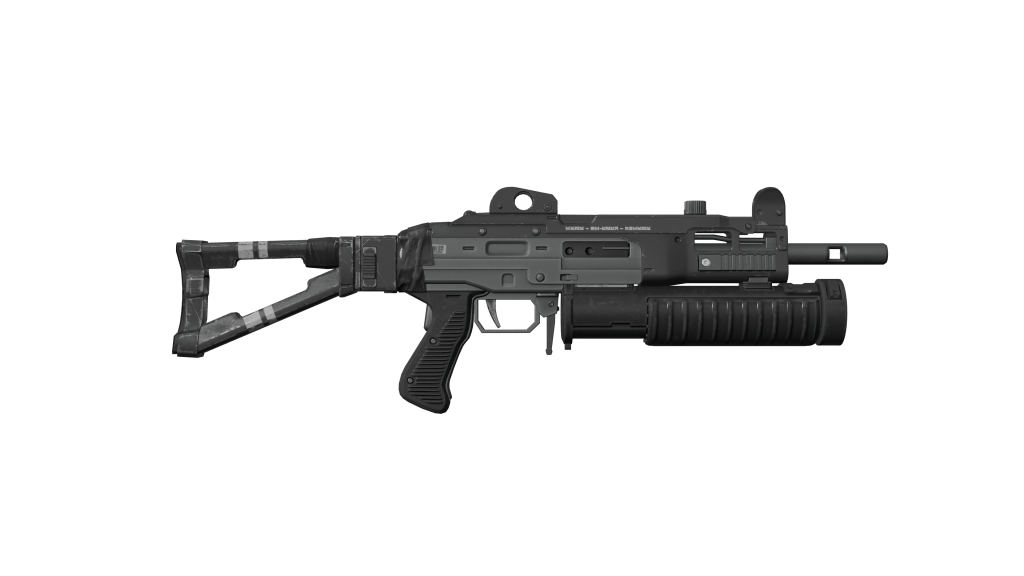
Primary roles: Greater Chaff Killer, Utility
Secondary roles: Lesser Chaff Killer, conditional Elite Killer
The Killzone StA-11 shares the Knight’s basic 90 standard / 18 durable projectile profile.
That means their fundamental damage breakpoints are extremely similar.
The meaningful differences are in delivery.
The StA-11 fires at 1,050 RPM instead of 1,380 and has less baseline sway. It cannot be customized and only fires automatically, but that slightly lower cyclic rate makes individual taps much easier to control.
That places it in a useful middle ground.
The Knight leans harder into maximum burst output.
The StA-11 gives up some of that ceiling for easier practical control.
It is still more than capable of rapidly cutting apart Greater Chaff or vulnerable Elites, but it is easier to feather the trigger against smaller targets.
If you like the Knight concept but find its extreme fire rate excessive—or simply like the Killzone equipment—the StA-11 offers a very reasonable alternative.
M7S SMG: Stealth as a Primary Role
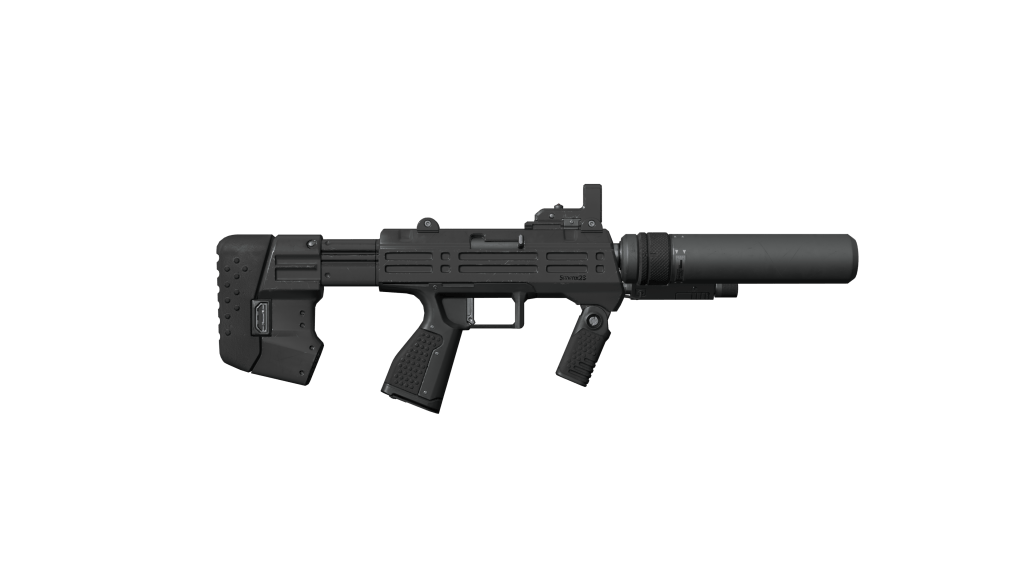
Primary role: Utility
Secondary roles: Greater Chaff Killer, Lesser Chaff Killer
The M7S is another member of the 90-damage SMG family, but its identity is not primarily raw killing power.
Its identity is suppression and stealth.
It deals 90 standard / 18 durable damage at 872 RPM, handles very comfortably, and gives you the one-handed trait.
More importantly, it is suppressed.
That makes it especially useful for selectively removing isolated enemies without immediately turning every engagement into a full-scale fight.
Against Automatons, for example, there is real value in quietly removing Troopers around a position before one of them gets the opportunity to call reinforcements.
The same concept applies elsewhere: selectively eliminate weaker guards or isolated targets while controlling when and how the larger engagement begins.
The suppressor does not mean enemies become magically oblivious. Nearby enemies can still become suspicious, investigate, or be alerted by what is happening around them.
The value is reduced detection and escalation—not invisibility.
Mechanically, its projectile behaves enough like the Knight/StA-11 family that I do not think endless redundant breakpoint testing is especially useful.
What makes the M7S worth bringing is that it changes how you initiate encounters.
SMG-32 Reprimand: The Primary-Slot Verdict
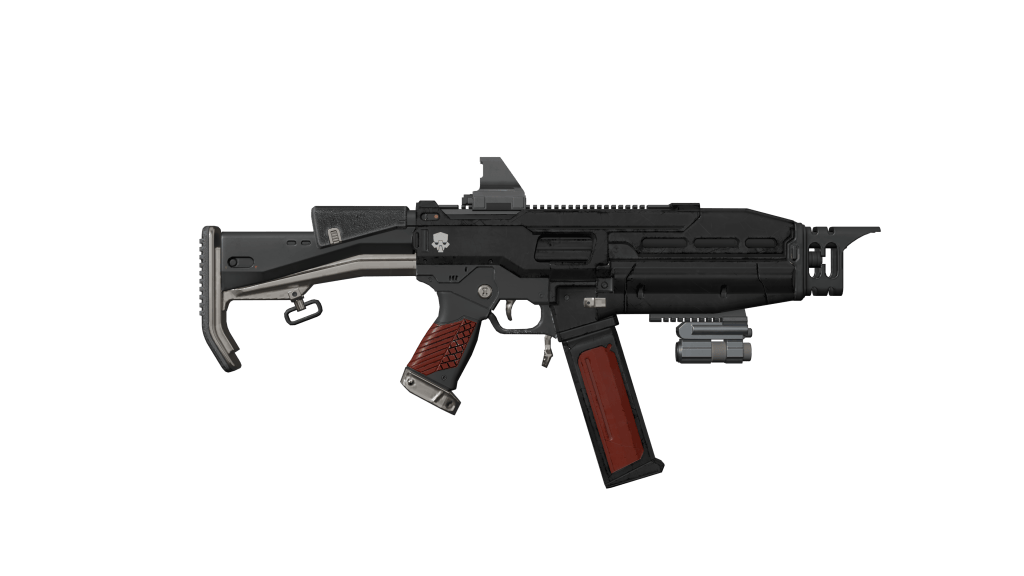
Primary roles: Elite Killer, Greater Chaff Killer
The Reprimand is one of the weapons that really changed how I thought about the entire SMG category.
It deals 140 standard / 32 durable damage, has Medium armor penetration, fires at 490 RPM, and carries only 25 rounds per magazine.
It is also the only current SMG in this group that is not one-handed.
This is a deliberate, precision-oriented weapon.
Semi-auto and three-round burst are extremely useful here.
Against an Overseer, for example, I have found the three-round burst particularly satisfying because three properly placed rounds can destroy the head at useful short ranges.
Likewise, it can pick away at vulnerable Automaton weak points when approaching a base.
You can use it automatically, but I think full-auto fire is best treated as the emergency option when a chunky enemy is suddenly too close for comfort.
The most revealing comparison is not another primary.
It is the P-113 Verdict sidearm.
The Reprimand and Verdict essentially use the same ballistic damage profile:
140 standard / 32 durable, Medium penetration.
The Reprimand then gives you:
- A 25-round magazine instead of 10
- Roughly 2.27 times the total ammunition
- Automatic and three-round-burst capability
- More useful optics
- Greater sustained primary-weapon capability
In exchange, the Verdict remains much more responsive and, importantly, one-handed.
So if you love the Verdict but wish you had a much larger, sustained-fire version of it in your primary slot, the Reprimand is basically that weapon.
And if you love what the Reprimand does but need one-handed utility, the Verdict gives you the inverse option.
That is one of the strongest examples of the primary-slot sidearm concept.
SMG-203 Gallant: The Medium-Penetrating Emergency Delete Button
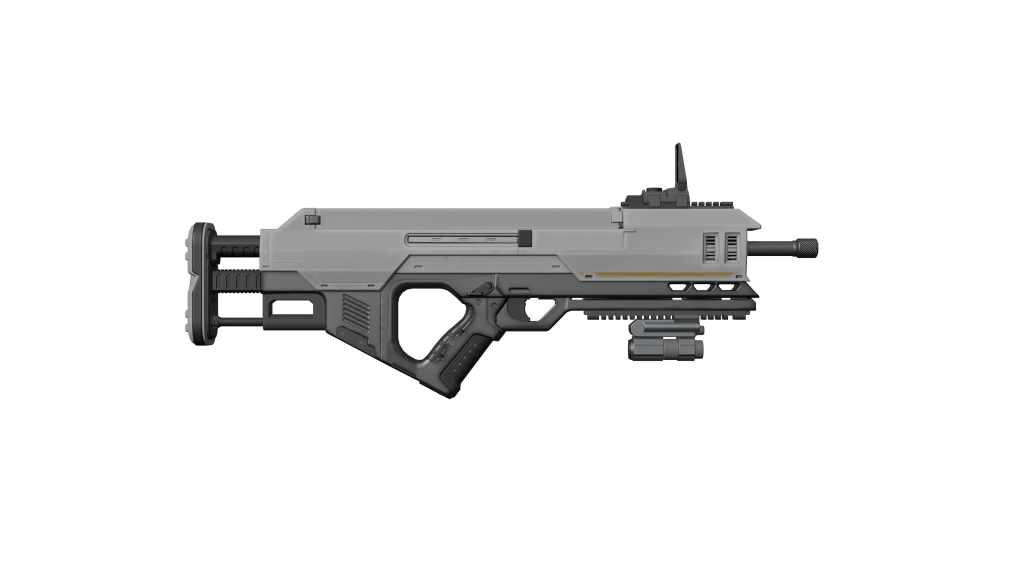
Primary roles: Elite Killer, Utility
Secondary role: Greater Chaff Killer
The Gallant shares the Knight’s insane 1,380 RPM, the same default 50-round magazine size, and the one-handed trait.
But the projectile is fundamentally different.
Instead of the Knight’s 90/18 Light-penetrating round, the Gallant fires 65/13 Medium-penetrating rounds.
That means it has the lowest listed damage per shot among the ballistic SMGs here and only 26,000 raw damage across its complete combat load.
For comparison, the Knight carries 36,000.
That is a huge difference.
So why take the Gallant?
Because penetration changes which targets those bullets can efficiently attack.
The Gallant is my “break glass in case of emergency” SMG for chunky Light- and Medium-armored targets that have gotten too close.
Devastators, Overseers, Hive Guards and other targets that actually justify Medium penetration are where its ammunition starts paying for itself.
Its 1,380 RPM lets you dump a tremendous quantity of Medium-penetrating fire into something almost instantaneously.
But exactly like the Knight, trigger discipline matters.
Spending a dozen Medium-penetrating Gallant rounds killing disposable Lesser Chaff is a terrible way to use a weapon with only 26,000 total raw ballistic damage.
Use semi-auto when one bullet will do.
Use bursts when a few will do.
Then let the weapon scream when something actually deserves 1,380 RPM.
SMG-72 Pummeler: Mobile Crowd Control
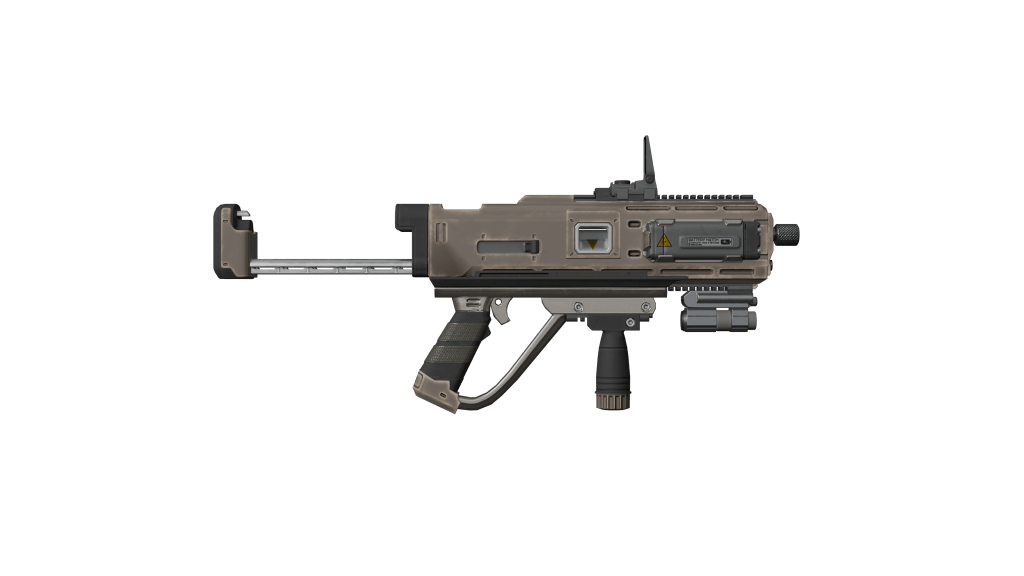
Primary roles: Crowd Control, Utility
Secondary roles: Lesser Chaff Killer, Greater Chaff Killer
The Pummeler has the lowest theoretical DPS of the class at roughly 673 DPS.
That is not a failure.
It is telling you what the gun is for.
The Pummeler deals 85 damage at 475 RPM, handles very comfortably, is one-handed, and applies stun.
In my testing, a Warrior takes roughly three rounds to stun, while an Alpha Commander takes roughly five. The stun then buys several seconds of breathing room.
That makes the Pummeler extremely good at creating time and space.
One of my favorite ways to conceptualize it is as a weapon that makes somebody else’s damage better.
Pair it with a Guard Dog.
Pair it with a Rover.
Pair it with a machine gun sentry.
Pair it with teammates.
While those sources are doing the killing, you are preventing Greater Chaff and susceptible Elites from reaching them.
Three-round burst is particularly intuitive here because some useful stun thresholds naturally fall into small controlled bursts.
This is why DPS rankings alone can be so misleading.
The Pummeler is not competing with the Knight at being a 2,000-DPS bullet hose.
It is competing on battlefield control.
SMG-37 Defender: The Baseline and Jack-of-All-Trades
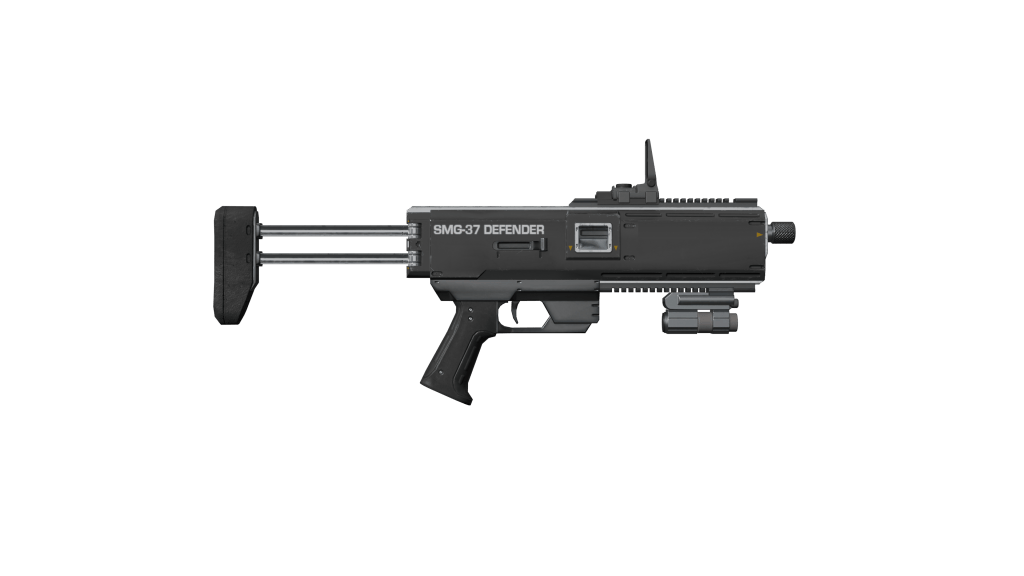
Primary roles: Greater Chaff Killer, Utility
Secondary role: Lesser Chaff Killer
The Defender is still my personal favorite SMG.
It also happens to be one of the easiest weapons in the class to recommend.
You get it through the base Helldivers Mobilize Warbond, and it does almost everything reasonably well.
It deals 110 standard / 22 durable damage at 520 RPM, has excellent practical handling, low recoil, one-handed utility, and multiple firing modes.
Its default 45-round magazine contains 4,950 raw damage.
Its total ballistic combat load contains 39,600 raw damage—the highest of the current SMGs in this comparison.
The Defender does not have the Knight’s absurd burst output.
It does not have the Reprimand’s Medium penetration.
It does not have the Pummeler’s stun.
It does not have the M7S’s suppressor or the Stoker’s flamethrower.
It simply works.
That makes it the class’s reference point.
Other SMGs are largely asking you to surrender some part of the Defender’s versatility in exchange for specialization.
For me personally, there is also a fun role-playing reason to use it. With the right configuration, I can make it feel like a primary-slot approximation of Leon Kennedy’s upgraded Matilda from the Resident Evil games.
And frankly, sometimes that is reason enough.
Fun first, meta second.
Ammo Economy Is More Than “How Many Bullets Do I Have?”
This is one of the areas where I think weapon discussions frequently become too simplistic.
When I say ammo economy, I am not simply talking about magazine size or how many rounds your character carries.
I am talking about how efficiently you convert your available ammunition into useful combat results.
That includes several overlapping forms of efficiency.
Breakpoint efficiency
How many rounds does it actually take to kill the target or destroy the component?
If an enemy dies in three bullets, bullets four through eight did nothing useful.
Damage efficiency
How much of each projectile’s damage actually mattered?
Shooting a 130-damage Stoker round into something with 60 relevant HP is substantial overkill.
Sometimes that is unavoidable or completely acceptable.
But repeatedly spending twice the necessary damage on targets affects the weapon’s practical economy.
Penetration efficiency
Are you paying for armor penetration the target does not possess?
This does not mean additional penetration literally consumes extra ammunition.
It means the weapon was balanced around having that capability, often at the expense of damage, ammunition, handling, or some other property.
If you bring Medium penetration and spend the entire mission shooting Unarmored targets, you may be leaving part of the weapon’s design budget unused.
Delivery efficiency
Can you actually put the necessary bullets into the target?
Recoil, sway, extreme fire rate, bullet velocity, range, target movement, and the player’s own accuracy all matter.
A theoretical six-shot kill is irrelevant if you habitually fire 14 rounds to accomplish it.
Role efficiency
Finally, are you actually spending ammunition on targets that exploit what the weapon is designed to do?
This is where player knowledge becomes a huge part of ammo economy.
The extreme version is obvious: nobody would fire an anti-tank rocket into every Scavenger and then conclude the launcher has terrible ammunition economy.
The exact same principle applies to primaries—just on a smaller scale.
The Hidden Variable: Durable Damage
This is where the written version needs an important addition that I did not explore in depth during the video.
After publication, a viewer reasonably asked:
“What about durable damage?”
That question matters.
Unfortunately, Helldivers 2 does not show a weapon’s durable-damage value in the normal Armory interface.
Players see listed standard damage and armor penetration, but a large part of the real damage calculation is hidden.
Every enemy component can possess its own durability percentage. The game blends the projectile’s standard and durable damage according to that percentage. For example, a 70%-durable component uses only 30% of the projectile’s standard damage contribution and 70% of its durable-damage contribution.
Conceptually:
Damage before armor = Standard Damage × (1 − Durability) + Durable Damage × Durability
Then armor penetration enters the equation.
If penetration exceeds the target component’s armor, the hit receives the full applicable damage.
If penetration merely matches the armor, it deals 65%.
If penetration is below the armor value, it does not penetrate that component.
That creates an important distinction:
Penetration should be matched to armor. Durable damage should be matched to durability.
The trouble is that only one of those is clearly visible to the average player.
A Practical Durability Rule for Players Who Don’t Want a Spreadsheet
Because the durable-damage stat is hidden, I do not think normal players should be expected to memorize hundreds of weapon-versus-body-part calculations.
So I wanted a simple guideline that works most of the time, while still acknowledging the exceptions.
My recommendation is:
Against durable Unarmored targets, Light-penetrating weapons will often give you better efficiency because they tend to retain more raw damage while the extra penetration of a Medium-penetrating alternative provides no benefit.
Against durable Light-armored targets, Medium-penetrating weapons tend to gain efficiency because they overmatch the Light armor instead of merely matching it.
There is overlap.
The exact weapon, exact body part, HP pool, durability percentage and hidden durable-damage value can change individual breakpoints.
But as a player-facing rule of thumb, I think that is useful.
An even simpler version is:
Soft and fleshy: prioritize damage. Armored and chunky: prioritize penetration.
That is deliberately not an absolute law.
It is guidance for somebody looking at the weapon selection screen without having a wiki spreadsheet open beside it.
Knight vs. Gallant: A Near-Perfect Example
The Knight and Gallant illustrate the principle unusually well because they fire at the same 1,380 RPM, both hold 50 rounds, and their durable-damage ratios are essentially identical:
Knight: 90 standard / 18 durable = 20%
Gallant: 65 standard / 13 durable = 20%
The Gallant is explicitly a Knight variant that sacrifices damage for Medium armor penetration.
Because their durable ratios are the same, increasing enemy durability reduces the two rounds proportionally by almost exactly the same amount.
That means armor becomes the big separator.
Against an Unarmored target, the Knight simply keeps its larger 90/18 damage profile.
Against Light armor:
Knight: Light AP matches Light armor → 65% modifier
Gallant: Medium AP exceeds Light armor → full applicable damage
Before durability even matters:
Knight: 90 × .65 = 58.5
Gallant: 65 × 1.00 = 65
So despite having a much smaller number printed on the weapon card, the Gallant can actually produce more effective damage per projectile against Light armor.
That is the entire reason the comparison flips.
Fleshmob: Where the Knight Pulls Ahead
A Fleshmob is a good example of the opposite situation because its major relevant body areas are poorly armored while possessing substantial health and durability.
The Gallant’s Medium penetration is therefore not buying an armor-multiplier advantage.
Its 65/13 projectile simply has less damage available than the Knight’s 90/18 projectile.
That is why the Knight is an excellent full-auto weapon against something like a Fleshmob.
The wiki itself recommends continuous automatic Gallant fire against high-health, durable, low-armor targets such as Fleshmobs—but if we’re specifically comparing the Gallant to the Knight, the Knight has the stronger ammunition-efficiency profile for that kind of soft, chunky target.
The Gallant works.
The Knight simply spends less ammunition doing essentially the same job.
Alpha Commander: Where Medium Penetration Starts Paying You Back
The Alpha Commander provides an excellent counterexample.
Its head has:
250 HP
Light armor
70% durability
Its main body also carries Light armor and 70% durability.
That combination is almost tailor-made to reward Medium armor penetration.
The wiki specifically notes that Medium-penetrating weapons and explosives are more effective against Alpha Commanders because of the combination of Light-armored heads and high durability.
The Knight’s Light penetration only matches the armor.
The Gallant’s Medium penetration exceeds it.
So despite the Knight’s substantially higher listed damage, the Gallant can edge it out per projectile against those Light-armored durable components.
This is exactly the kind of target where the Gallant’s design budget starts earning its keep.
This Pattern Extends Beyond SMGs
I also checked similar Light-versus-Medium weapon pairs in other categories.
The regular AR-23 Liberator deals 90 standard / 22 durable damage with Light penetration.
The Liberator Penetrator deals 65/15 with Medium penetration.
That is strikingly similar to Knight versus Gallant.
Against a soft target, the regular Liberator gets to exploit its higher damage.
Against Light armor, however:
Liberator: 90 × .65 = 58.5 before durability adjustments
versus
Liberator Penetrator: 65 × 1.0 = 65
Again, the lower-damage Medium-penetrating variant can pull ahead once its penetration actually matters.
The same broader principle appears in the marksman rifles.
The standard R-63 Diligence hits substantially harder than many automatic weapons at 165/45, despite being Light penetrating. The Diligence Counter Sniper increases that to 200/50 while also gaining Medium penetration, but sacrifices handling, magazine capacity and ammunition.
That reminds us of something important:
Penetration alone never determines efficiency.
A sufficiently hard-hitting Light-penetrating projectile can still outperform a weaker Medium-penetrating projectile against some Light-armored targets.
That is why this remains a rule of thumb rather than a universal equation.
The Alpha Commander Head as a Cross-Class Case Study
If we use that 250-HP, Light-armored, 70%-durable Alpha Commander head as a test case, the broader relationship becomes obvious.
Weapons with substantial durable damage, high standard damage, Medium penetration—or some combination of all three—rise quickly.
The Slugger, for example, fires a 330 standard / 90 durable Medium-penetrating slug. The Counter Sniper fires 200/50 with Medium penetration. The regular Diligence only has Light penetration but starts from a much larger 165/45 damage profile.
That is why the actual answer to:
“How good is this gun against durable enemies?”
can never be determined from the penetration label alone.
You need:
- The target component’s HP
- Its armor
- Its durability
- The weapon’s standard damage
- Its hidden durable damage
- Actual shot delivery and range
And since the game does not show players all of those values, practical guidance has to accept some uncertainty.
Defender, Stoker and Reprimand Show the Spectrum
These three SMGs also make a useful comparison.
| Weapon | Standard | Durable | Durable Ratio | Penetration |
|---|---|---|---|---|
| Defender | 110 | 22 | 20% | Light |
| Stoker | 130 | 30 | ~23% | Light |
| Reprimand | 140 | 32 | ~23% | Medium |
If the target is completely Unarmored, the ordering is straightforward:
Reprimand > Stoker > Defender per bullet
But that does not automatically mean the Reprimand has superior ammunition economy.
The Defender carries 360 rounds.
The Stoker carries 270.
The Reprimand carries 250.
Against large quantities of softer enemies, the Defender’s ammunition depth can outweigh its weaker individual projectile.
Against a durable Light-armored target, however, the Reprimand’s Medium penetration suddenly becomes enormously valuable because it avoids the matching-armor penalty that the Defender and Stoker receive.
That is exactly why I categorize the Reprimand primarily as an Elite Killer / Greater Chaff Killer.
Its ammunition is most valuable when the target actually rewards both its high projectile damage and its Medium penetration.
Why I Didn’t Put All of This Math in the Video
There are currently eight SMGs in this comparison.
Then consider how many enemy types exist.
Then consider how many separately armored and separately durable body parts those enemies can have.
Now multiply that by distance-based damage falloff, projectile behavior, firing modes, attachments, and player accuracy.
You can very quickly turn a practical SMG guide into a two-hour spreadsheet lecture.
That was not what I wanted the video to be.
The goal was to give players a combat-role framework they could actually remember while choosing a loadout.
If you are specifically concerned about durability targeting, my practical advice remains:
Generally, use your Light-penetrating SMGs to maximize efficiency against durable Unarmored targets. Use your Medium-penetrating SMGs when you expect to repeatedly attack durable Light-armored targets. Expect some overlap depending on the weapon, enemy and exact body part.
That gives you useful guidance without pretending the hidden durable-damage system does not exist.
Concise Combat Roles for Every SMG
Putting everything together, this is where I currently place the class:
| Weapon | Primary Role(s) | Secondary Role(s) |
|---|---|---|
| MP-98 Knight | Greater Chaff Killer, Utility | Lesser Chaff, conditional Elite Killer |
| StA-11 | Greater Chaff Killer, Utility | Lesser Chaff, conditional Elite Killer |
| M7S | Utility | Greater Chaff, Lesser Chaff |
| SMG-37 Defender | Greater Chaff Killer, Utility | Lesser Chaff |
| SMG-72 Pummeler | Crowd Control, Utility | Lesser Chaff, Greater Chaff |
| SMG/FLAM-34 Stoker | Greater Chaff Killer, Utility | Crowd Control, Elite Killer, limited Heavy access |
| SMG-32 Reprimand | Elite Killer, Greater Chaff Killer | — |
| SMG-203 Gallant | Elite Killer, Utility | Greater Chaff |
There is currently no SMG I would classify as a true dedicated Tank Killer.
The Stoker can interact with Heavy armor through its flamethrower, but penetration capability alone does not automatically make something an efficient tank-killing weapon.
So Which SMG Should You Use?
I do not think there is a universally correct answer.
If you want maximum close-range burst against chunky soft targets, the Knight makes a strong case.
If you want something similar but easier to manage, the StA-11 is compelling.
If stealth is part of your plan, take the M7S.
If you want a high-damage hybrid with fire, take the Stoker.
If you want deliberate Medium-penetrating precision, the Reprimand is excellent.
If you want a one-handed Medium-penetrating buzzsaw for close-range emergencies, take the Gallant.
If you want mobile crowd control, take the Pummeler.
And if you want one weapon that simply does a little bit of everything comfortably, the Defender remains extremely difficult to dislike.
More importantly, understand why you selected it.
That is the point of combat roles.
A weapon is not good merely because its DPS number is high.
It is not bad merely because another weapon carries more ammunition.
And it is not automatically inefficient because somebody else missed half their shots, fired five unnecessary rounds into every Scavenger, or spent Medium-penetrating ammunition shooting nothing but Unarmored enemies.
The weapon, the target, the body part, the range, the player’s aim, and the rest of the loadout all interact.
Learn those relationships and the sandbox gets much larger.
And, at least for me, a lot more fun.
Fun first, meta second.
Sources and Further Reading
The companion video is Every SMG Explained by Combat Role | Helldivers 2. Watch the video on YouTube
For underlying weapon and damage mechanics, I referenced the current Helldivers Wiki data. Its damage documentation confirms that standard and durable damage are blended according to each target component’s durability, while penetration exceeding armor deals full damage and matching armor deals 65%.
The Alpha Commander is particularly useful as a case study because its head and main body combine Light armor with 70% durability, and the wiki itself recommends Medium penetration against those areas.
Current weapon data referenced in the expanded durability discussion includes the Knight, Gallant, Liberator, Liberator Penetrator, Diligence, Diligence Counter Sniper and Slugger.
Helldivers 2 wiki: https://helldivers.wiki.gg/
For Super Earth.
 Radekin Gaming
Leave a comment