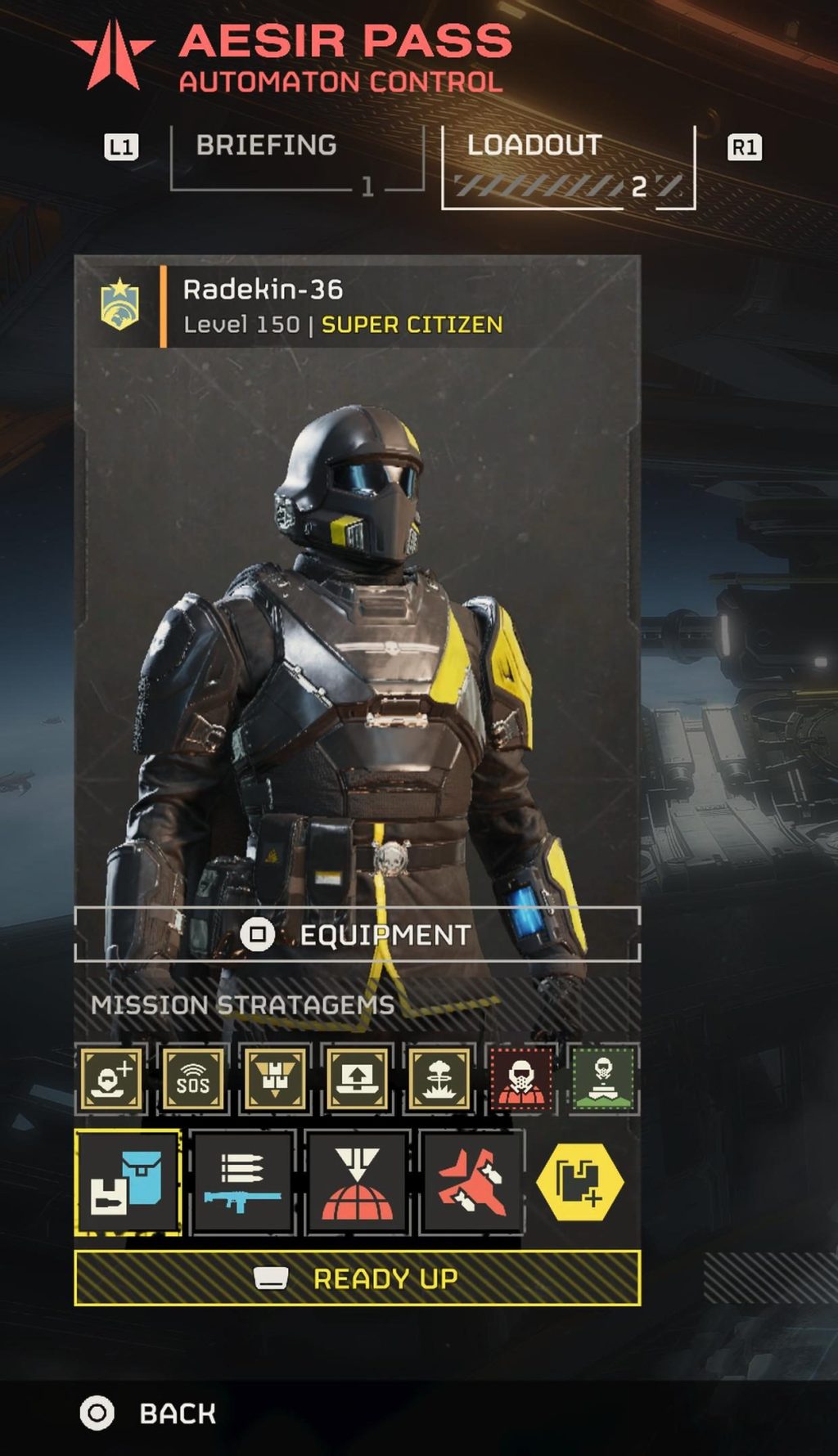
A good Helldivers 2 loadout is not about finding one weapon that solves every problem. It is about understanding what each slot is normally for, how your weapons support each other, and how your armor, throwables, support weapon, and stratagems complete the full kit.
Before breaking down individual weapons in Helldivers 2, it helps to define what each part of the loadout is actually for.
A primary weapon is not supposed to solve every battlefield problem by itself.
Neither is your secondary.
Neither is your throwable.
Even your support weapon and stratagems should not be judged in isolation.
In Helldivers 2, your loadout is a full kit. Your primary weapon, secondary weapon, throwable, armor, support weapon, and stratagems are all supposed to work together. Each slot has a different baseline purpose, a different level of reliability, and a different opportunity cost.
That matters because one of the biggest mistakes players make is judging a primary weapon as if it should handle everything by itself: patrols, base guards, elite enemies, heavy units, tanks, bug breaches, bot drops, objectives, and spawner destruction.
That is not how the game is built.
The loadout is the weapon system.
A weapon might be a chaff killer, an elite killer, a crowd control tool, a utility option, a heavy killer, or a tank killer. Some weapons are specialized. Some overlap between multiple roles. Some are not amazing at any one thing, but they give you a flexible answer to several problems at once.
But the real question is not, “Can this weapon do everything?”
The better question is:
What job does this weapon reliably bring to the full loadout?
The Basic Loadout Philosophy
At the broadest level, your stratagems are your major problem-solvers.
Offensive stratagems, support weapons, supply tools, and defensive stratagems are what you usually rely on when enemy reinforcements are called in, when you are assaulting larger bases, when heavy units enter the fight, or when you need to break through a major objective area.
Your primary weapon, by contrast, is usually your main tool for normal mission flow.
That means patrols, standing guard units around bases, smaller groups before things escalate, and the regular fighting that happens between major events.
Your secondary weapon usually exists to support your primary. Sometimes that means giving you a fast emergency option. Sometimes it covers a range gap, an armor gap, an ammo-efficiency gap, or a utility gap. But in most cases, your secondary should be viewed as an extension of your carried weapon setup, not as a replacement for the rest of your kit.
Your throwable fills a similar support role. Grenades and throwable tools can give you burst damage, crowd control, area denial, emergency space, defensive utility, or spawner destruction. The throwable slot can meaningfully change what your primary and secondary need to cover.
There are exceptions, of course. Some primaries, secondaries, grenades, armor passives, and supply-based setups can be built around more heavily. A supply backpack, for example, can let you lean harder into grenade use or ammo-hungry weapons. Certain niche weapons can also push a slot beyond its usual baseline role.
But as a general rule:
Stratagems are for the big problems.
Your primary, secondary, and throwable are mostly there for the regular fighting that happens between those big moments.
That distinction gives us a fairer way to judge primary weapons.
The question is not:
Can this primary do everything?
The better question is:
What part of the normal mission flow does this primary handle well, and what does the rest of the loadout need to cover?
Primary Weapon: Your Main Workhorse
Your primary weapon is the tool you should expect to use most during normal mission flow.
It is what you spawn with. It is what you respawn with. It is usually easy to refill from ammo boxes and supply boxes. It usually has more total ammo available than your secondary weapon. So when you choose a primary weapon, the real question is not, “Can this replace my entire loadout?”
The better question is:
What kind of regular fighting do I want this weapon to handle?
For most primary weapons, that answer is going to be chaff killing, elite killing, crowd control, utility, or some combination of those roles.
Most primary weapons are built around light armor penetration or medium armor penetration. That means they are usually best suited for killing light enemies, light armored elites, medium armored elites, or enemies with specific exposed weak points.
That does not mean primary weapons can never help against heavier enemies. Some heavy enemies have weak points that are not protected by heavy armor.
For example, a Hulk’s back vent can be damaged by weapons that would not normally be considered dedicated heavy-killer tools. A weapon like the SG-97 Sweeper or DBS-2 Double Freedom can dump a lot of medium-penetrating damage into that exposed vent and potentially take the Hulk down.
But that is different from saying those weapons are true anti-heavy weapons.
They can exploit exposed weak points. They are not dedicated heavy-killer or tank-killer tools.
That distinction matters.
A primary weapon does not need to kill everything. It needs to give you a dependable answer to the enemies and situations you expect to face during normal mission flow.
Secondary Weapon: Your Complement, Backup, or Efficiency Tool
Your secondary weapon should not be treated as an afterthought.
It is not just the thing you pull out when your primary runs dry.
A secondary weapon can patch a weakness, but it can also smooth out your playstyle, preserve ammo, handle inefficient targets, or give you a faster answer to a specific problem.
For example, let’s say your primary weapon is the DBS-2 Double Freedom.
That shotgun gives you massive medium-penetrating burst damage, but it has clear limitations. You only get two semi-auto shots or one volley before reloading, and the reload is slow. That makes it excellent for deleting big, beefy targets, but inefficient against one or two small chaff enemies.
In that case, something like the P-2 Peacemaker makes a lot of sense as a secondary.
It is light armor penetrating, fast-handling, snappy, and can quickly dispatch a small group of chaff without wasting your Double Freedom shots.
That is not just an emergency backup.
That is loadout synergy.
The secondary is helping the primary do its job better by taking smaller, inefficient targets off its plate.
So when choosing a secondary, I would ask:
What does my primary weapon not want to waste time or ammo doing?
Sometimes the answer is chaff cleanup. Sometimes it is quick precision damage. Sometimes it is panic defense. Sometimes it is utility. Sometimes it is simply giving yourself a faster option while your primary is reloading.
The point is that your secondary should make your overall weapon flow better.
Throwable: Your On-Demand Burst Tool
Your throwable is another major part of your carried kit.
Like your primary and secondary, it comes with you when you spawn and respawn. But unlike your primary or secondary, it usually gives you a limited-use burst effect.
That effect can be damage, crowd control, utility, defense, area denial, or structure destruction.
A standard high-explosive grenade can give you utility by destroying spawners. A heavier explosive like the Giga Grenade can supplement your anti-heavy or anti-tank plan. An Arc Grenade can help with chaff clear and crowd control. A stun grenade, gas grenade, or shield throwable can create space, lock enemies down, or give you defensive breathing room.
So the throwable question is:
What do I want available on demand in limited bursts?
Your throwable might reinforce what your primary already does well, or it might cover a completely different role.
It depends on what kind of loadout identity you are building.
Armor: Your Passive Loadout Modifier
Armor is not just defense.
Armor is part of your loadout’s performance.
Light, medium, and heavy armor affect survivability, movement speed, stamina capacity, and stamina regeneration. But the armor passive is where loadout synergy becomes even more interesting.
Your armor passive can make your weapons feel better, make your reload rhythm smoother, increase sustain, improve survivability, improve stealth, improve throwing range, improve recoil control, or push your entire loadout toward a specific role.
For example, the B-01 Tactical is medium armor with Extra Padding. It is one of the most versatile, well-rounded armor choices in the game. It gives you better survivability while keeping medium armor movement and stamina. It is not specialized for one specific playstyle, but it works with almost anything because more survivability is always useful.
But if you want to lean harder into your primary weapon, you might choose something like DP-8 Mountain Scaled with Siege Ready.
Siege Ready increases reload speed of primary weapons by 30% and increases ammo capacity of all your weapons by 20%.
That can make a primary weapon much more reliable as your main workhorse.
So if you bring the AR-23 Liberator as your dedicated chaff killer, Siege Ready can reinforce that role. Faster reloads and more ammo allow the Liberator to shred through larger waves of light enemies more consistently.
Now your primary weapon and armor passive are working together to fully cover a combat role.
And once you know your chaff killing is handled by the Liberator plus Siege Ready, the rest of your loadout opens up. Your secondary and throwable can focus more on medium enemies, utility, crowd control, heavy damage, or emergency defense. Your support weapon and stratagems can then be dedicated to the bigger problems your carried kit does not solve as efficiently.
That is why armor should not be treated as separate from your weapons.
Armor is the passive that tells the rest of your loadout what kind of game you are trying to play.
Support Weapon: Your Specialized Combat Tool
Support weapons are different from primaries, secondaries, and throwables because they come with a bigger opportunity cost.
A support weapon uses one of your four stratagem slots. You usually have to call it down. If you die, you may have to recover it. If it is expendable, you may have to wait for another cooldown before you can access it again.
So support weapons can be much stronger than primary weapons, but they are not as guaranteed.
That is the tradeoff.
A support weapon is usually your specialized combat tool. It can cover almost any role depending on what you bring. Some support weapons are chaff killers. Some are elite killers. Some are crowd control tools. Some are heavy killers. Some are tank killers. Some bring demolition force for structures and objectives. Some bring specialized utility.
But because you are spending a stratagem slot on it, the support weapon should give you a strong return on investment.
The question is:
What problem am I willing to spend a stratagem slot to solve extremely well?
If your carried kit already handles chaff and elites, maybe your support weapon needs to kill heavies or tanks. If your primary is specialized for elite killing but struggles into large crowds, maybe your support weapon needs to bring sustained chaff clear. If your throwable and offensive stratagems already handle heavies, maybe your support weapon can be chosen for flexibility, ammo economy, or team support.
The support weapon should not be judged the same way as a primary weapon.
A primary is valuable because it is always available during normal mission flow.
A support weapon is valuable because it gives you a powerful payoff for the stratagem slot you invested.
Offensive Stratagems: Your Big-Impact Tools
Offensive stratagems are for major battlefield swings.
These are the tools you call in when there is a dangerous enemy concentration, a reinforcement wave, a heavy unit, a tank, a fortified position, a structure, a spawner, or an objective area that needs to be cracked open.
That does not mean you should never use offensive stratagems on smaller fights. Sometimes it makes sense to end a problem quickly before it grows into a bigger one.
But in the basic loadout framework, offensive stratagems are usually not replacing your primary weapon. They are solving larger problems that your carried kit either cannot handle efficiently or cannot handle safely.
So the offensive stratagem question is:
What major threat or battlefield situation do I want to delete, weaken, or control from a distance?
Supply Stratagems: Your Sustain and Aggression Tools
Supply stratagems change how aggressively the rest of your kit can be used.
A supply backpack, for example, can let you lean harder into grenade use, ammo-hungry weapons, stim-heavy survival, or team support. Other supply tools can make a loadout more forgiving, more aggressive, or more sustainable over longer fights.
This matters because ammo economy is part of weapon performance.
A weapon that feels limited in a normal loadout may feel completely different when backed by supply support. A grenade-heavy playstyle becomes more realistic when you can keep replenishing your throwables. An ammo-hungry primary becomes easier to justify when your loadout is built around keeping it fed.
So the supply stratagem question is:
What part of my kit do I want to use more often, more aggressively, or for longer?
Defensive Stratagems: Your Space-Control Tools
Defensive stratagems are for holding ground, controlling space, protecting objectives, slowing enemy movement, and stabilizing chaotic fights.
These tools are especially valuable when the mission forces you to stay in one place, when enemies are approaching from predictable directions, or when your squad needs time and space to reload, resupply, recover, or complete an objective.
Defensive tools can also change how your weapons perform in practice. A weapon that struggles under pressure might feel much better when a defensive stratagem buys you space. A squad that would normally get overrun can become much more effective when the battlefield is shaped in its favor.
So the defensive stratagem question is:
How do I want to create safety, space, or control when the fight gets chaotic?
Cleaner Slot Breakdown
Primary weapon:
Your main workhorse for normal engagements: patrols, base guards, small-to-medium groups, and general fighting between major events.
Secondary weapon:
A backup or complement to the primary. It may cover emergencies, close range, precision, armor gaps, utility, or ammo-saving situations.
Throwable:
A flexible support tool. It may provide burst damage, crowd control, spawner destruction, area denial, defense, or emergency space.
Armor:
Your passive loadout modifier. It changes your survivability, mobility, stamina, and the way your weapons or playstyle perform.
Support weapon:
Usually your specialized combat tool. Often used for heavies, elites, armor, sustained damage, demolition, or a job your primary is not built to handle.
Offensive stratagems:
Big-impact tools for enemy concentrations, heavy units, structures, breaches, drops, objectives, and dangerous escalations.
Supply stratagems:
Tools that let the rest of your kit function longer or more aggressively, especially ammo-hungry setups, grenade-heavy setups, stim-heavy setups, or team support builds.
Defensive stratagems:
Tools for holding ground, controlling space, protecting objectives, slowing enemy movement, or stabilizing chaotic fights.
Individual Loadouts vs Coordinated Team Loadouts
This framework is mainly written through the lens of an individual player.
That means solo players, players entering quickplay, or anyone joining a match where they do not know what the rest of the squad is bringing. In that kind of situation, it usually makes sense to build a more self-sufficient loadout.
You probably want some kind of answer to chaff, elites, heavies, tanks, utility, and survival, because you cannot assume your teammates will communicate, coordinate, or cover the roles your loadout does not handle well.
That is where the jack-of-all-trades mindset makes sense.
But that is not the ceiling of Helldivers 2 loadout building.
Once you have a coordinated team that communicates and builds around each other, the level of synergy skyrockets. A coordinated squad can specialize harder, divide responsibilities more intentionally, and capitalize on teamwork mechanics that a solo player or random quickplay group may not be able to use as effectively.
Team reloading is one obvious example. Certain weapons become much more efficient when another player helps keep them fed.
Team-oriented equipment also changes the equation.
The Grenadier Battlement gives the squad both offensive grenade launcher support and a defensive barricade. The Directional Shield can protect not only the user, but also teammates positioned nearby. The Shield Generator Relay can create a protected space for the whole squad. Recoilless Rifle can rapidly destroy heavy and tank units if two players use the team reload feature. Vehicles like tanks and FRVs allow the team to move, fight, and reposition together from a shared platform.
Some players may argue that Helldivers 2 does not really embrace teamwork or team roles because it does not force players into premade classes or strict role assignments. But I think that freedom is part of the brilliance of the game.
Helldivers 2 does not handcuff players into being “the tank,” “the healer,” “the anti-tank guy,” or “the crowd control guy.”
Instead, it gives players the tools and lets them decide how much teamwork they want to embrace.
You can build a self-sufficient solo loadout, a jack-of-all-trades quickplay loadout, or a highly specialized coordinated squad loadout. The game allows all of those approaches.
Now, I do think there is room for Arrowhead to eventually add better social systems. An in-game clan system, better squad planning tools, or clearer ways to indicate intended roles could help players coordinate more easily.
But even in its current state, the game already supports everything from solo independence to full squad synergy.
The difference comes down to what the players involved choose to do with the tools available.
So the individual framework is not the final form of loadout building.
It is the baseline.
For solo and quickplay, build for self-sufficiency.
For coordinated squads, build for specialization, synergy, and role division.
A well-built individual loadout can perform very well. But a coordinated team that fully embraces weapon roles, armor passives, stratagem synergy, team reloads, defensive tools, vehicles, and communication will always have a much higher ceiling than a solo player or an average random group of Helldivers.
The Loadout Formula
So my basic loadout-building formula is:
First, pick your main workhorse for normal mission flow.
That is your primary weapon.
Second, choose how you want to augment that weapon.
That is your secondary and throwable.
Third, choose the passive that supports your intended playstyle.
That is your armor.
Fourth, spend stratagem slots on the biggest problems your starting kit does not solve efficiently.
That is your support weapon and other stratagems.
Put even simpler:
Primary weapon: What part of normal mission flow do I want to handle reliably?
Secondary weapon: What do I want to smooth out, conserve ammo for, or cover quickly?
Throwable: What burst damage, control, defense, utility, or spawner destruction do I want on demand?
Armor: What passive do I want modifying my whole playstyle?
Support weapon: What problem am I willing to spend a stratagem slot to solve extremely well?
Offensive stratagems: What major threats, enemy groups, structures, or objective areas do I need to hit hard?
Supply stratagems: What part of my kit do I want to sustain or use more aggressively?
Defensive stratagems: How do I want to create safety, space, distract, or control when the fight gets chaotic?
That is the framework.
A good loadout does not need every individual weapon to do everything. A good loadout needs the full kit to cover the right jobs with the right level of reliability.
Your primary weapon handles the regular fighting.
Your secondary and throwable shape how that primary feels in practice.
Your armor passive can turn a good weapon-role pairing into a complete playstyle.
Your support weapon and stratagems are where you make bigger investments into the problems that matter most.
That is why I rank weapons by role, not by some vague idea of “best” or “trash.”
The real question is not:
Can this weapon kill everything?
The real question is:
What role does this weapon reliably bring to the loadout, and what does the rest of the kit need to do around it?
That is how I think players should approach Helldivers 2 loadout building.


Leave a comment